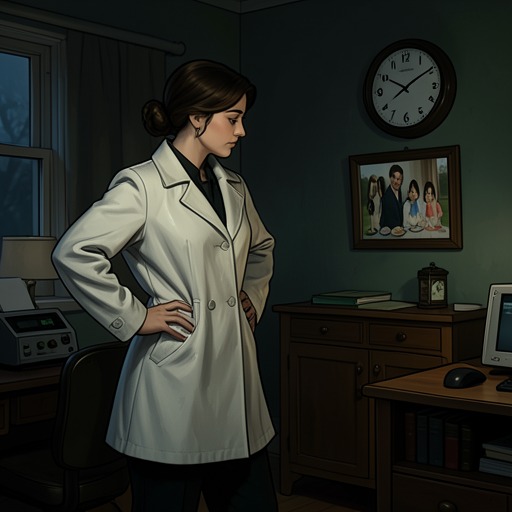
The Wong family's expectation that Ever become a doctor
Loveboat, TaipeiThe Wong family's expectation that Ever become a doctor is both a practical career plan and an inheritance of sacrifice. Her parents' difficult migration and economic history give the profession emotional weight: medicine stands for security and for the possibility that their daughter can reach a life they could not. Ever ultimately refuses that plan, not by denying what her parents endured, but by arguing that their courage also gives her room to take a risk of her own.
Origins and Family Stakes
Ever understands the expectation through the details of her parents' past. Her father grew up without shoes until age nine, and his mother stretched meals with noodles and small scraps of meat. After he came to America, paved roads seemed remarkable because he had known dirt roads; later, when Ever rejected meat as a child, he ate it rather than let food go to waste. These memories make the family's relative security feel hard-won rather than automatic.
The family's present-day experience sustains that sense of precarity. Ever recalls immigration officers pressing her parents, dried-out dragon fruit, and her mother's sale of her black pearl necklace to help send Ever to Taiwan to learn her family's culture. She feels that disappointing them repeats an old injury: it seems to her like rejecting the food her father once could not bear to waste. Their expectation is therefore bound up with material hardship, cultural connection, and a debt Ever feels even when she resents being reminded of it.
Medicine as Hope and Obligation
The medical future her parents imagine also carries her father's own unrealized professional life. He dreams of Ever attaining a position such as surgeon general while working as an orderly at the Cleveland Clinic. Ever connects his injury at work to that same long reach: he walked onto a spill while pushing his cart and did not see it. His hopes for her are not simply a demand for status; they are attached to a vision that his daughter's opportunities might make possible what his own circumstances did not.
Ever recognizes that her parents chose their plans with her future and happiness in mind. The molecular biology textbook they gave her was meant to prepare her, not to make her miserable. That recognition complicates her refusal: she cannot easily cast them as opponents when she believes their intention is care, even as their chosen route conflicts with what she wants.
The Great Divide
In Taiwan, Ever tries to explain why love and gratitude have not made the decision simple. She compares her situation with Megan's more readily understandable relationship with her parents and with cousins in China whose cultural expectations seem less divided from their own. Ever feels caught between American messages of individualism and self-actualization and her parents' experience of sacrifice and responsibility. The seven thousand miles between them become, in her account, more than distance: even if they stood together and spoke the same language, a divide would remain.
The conflict is not only about which career is useful. Ever fears that wanting dance at all is a betrayal, despite knowing that her parents want the best for her. The expectation has fused a profession with an emotional measure of filial responsibility; declining medicine can feel like declining the people who made her choices possible. Her eventual reasoning does not erase that burden, but changes its meaning: she sees risk-taking as something she has learned from them.
Refusal and Negotiation
After returning from Taiwan, Ever tells her parents she will not attend Northwestern in September. She says she does not want to be a doctor and has long known this beneath her fear of acknowledging it; the sight of blood also gives her vertigo. But she makes clear that blood is not the decisive reason. She wants to dance and create dances, and she believes she has ability enough to pursue that work.
She lays out a concrete alternative rather than asking her parents to accept an undefined wish. Ever plans to take a gap year, work as a dance instructor at Zeigler’s Ballet Studio, and apply to dance schools and scholarship programs for the following fall. She will use a film of the dance she choreographed in Taiwan as part of her application. She has also negotiated with Northwestern to recover the family's deposit, a practical step that shows she is taking responsibility for the consequences of her decision rather than merely rejecting her parents' plan.
Her mother answers with economic fears: dance may not provide a living, starting over may fail, and medical schools may not take Ever later. She insists that Ever finish medical school and dance on the side, then accuses her of ingratitude after all the family has done. Ever's repeated insistence that she is not going to medical school marks the point at which explanation becomes a boundary. Her mother leaves the room; her father remains stunned, but not angry, and Ever recognizes that some hard-won trust between them is still intact.
Recasting Inheritance
Ever answers the charge of ingratitude by naming what her parents themselves risked. They came to America without their families, and her father gave up medicine so that his children could grow up there. She describes those choices as brave: they surrendered security and took risks in pursuit of something larger. Ever then claims a parallel, not an identical life. She wants to take a risk for dance and use her work to draw attention to people who are otherwise overlooked.
That conclusion neither promises that her parents will agree nor makes the economic stakes disappear. It reframes their sacrifice as an example of courage rather than a bill she can repay only by entering medicine. The expectation that she become a doctor remains a powerful expression of family care and insecurity, but it no longer determines what gratitude must look like. Ever's choice carries her parents' history forward while allowing her to pursue a future of her own.